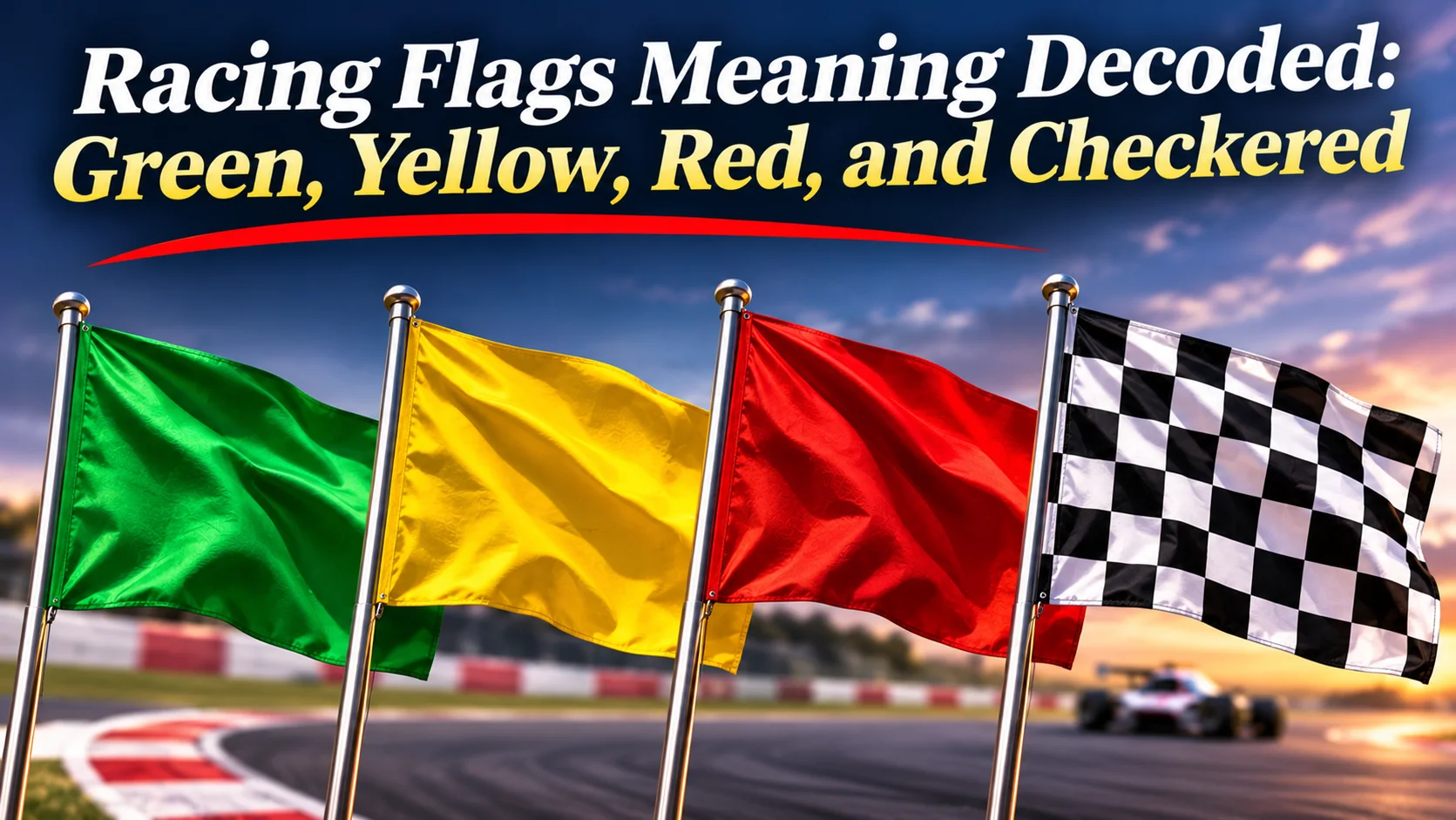
Racing flags meaning starts with one idea: officials use flags to communicate messages around the track. Each flag color and waving method signals a specific instruction. Flags indicate incidents, caution periods, and session status. Bettors who observe flag activity can track position changes and timing adjustments accurately.
Core Principles Of Track Flag Signals
At motorsport events in the United States, officials communicate with drivers by displaying flags. Race control also supplies a reference, allowing viewers and bettors to identify racing flags and what they mean within each series.
| Aspect | Detail |
|---|---|
| Primary function | Control driver behavior |
| Signal source | Race control officials |
| Scope type | Local or full course |
| Visibility standard | Corner station posted |
| Movement meaning | Stationary vs waving |
| Timing impact | Clock pauses or runs |
| Lap count effect | Laps added or held |
| Electronic mirror | Light panels replicate flags |
| Series variation | Rules differ per championship |
| Number association | Identifies one specific car |
Green Flag Role At The Line
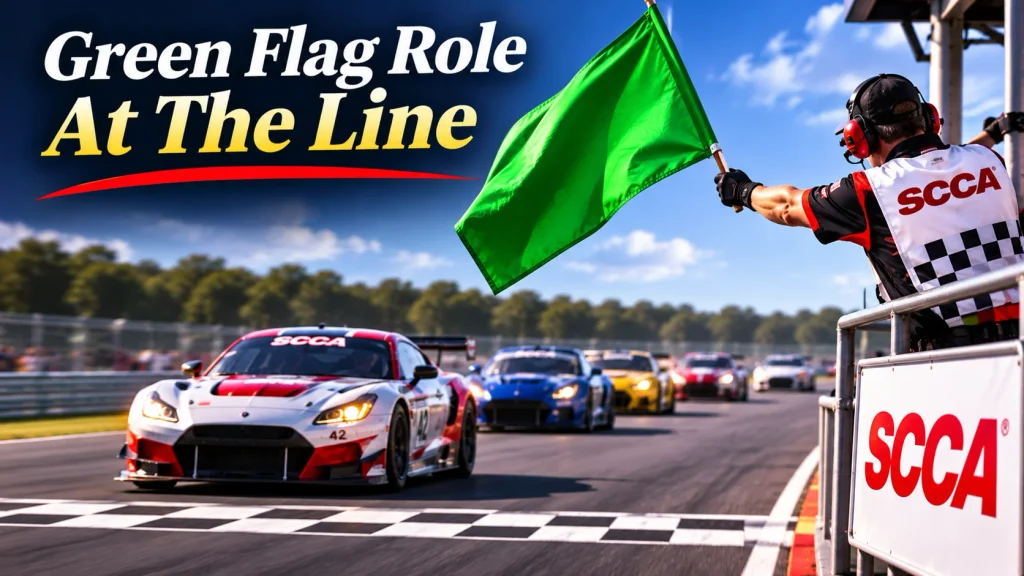
The starter displays a green signal indicating the circuit is open and drivers can proceed at racing speed. The green signal marks the start or restart of a session and informs drivers that any previous danger warning has ended. Race officials use this signal in all US series, including NASCAR, IMSA, and SCCA. The green flag applies in the following cases:
- Race start at the line;
- Restart zones after cautions;
- Practice session activation;
- Qualifying session activation;
- Cancels prior danger signals;
- Drivers resume full competitive pace;
- Viewers identify active track conditions.
Single Yellow Flag Local Caution
The yellow flag racing meaning in US road and oval track events covers a localized zone of reduced activity. The yellow flag relates to worker safety and recovery vehicle clearance near the circuit surface. When the yellow flag is displayed, drivers must cut speed and restrict passing to one sector. Both drivers and viewers need to track which station displays the yellow flag. A single yellow flag has the following operational details:
- Stationary flag signals moderate danger ahead;
- Waving flag signals immediate elevated hazard;
- No-passing zones apply sector-wide only;
- Workers near the surface require clearance space;
- Recovery vehicles slow adjacent traffic flow;
- Lap times rise through the affected sector;
- Sector indicators on timing screens shift visibly;
- Other sectors remain fully active for position.
Double Yellow Flag Full Course Control
When race control announces a full-course double yellow, officials display double yellow flags at each US road circuit. Drivers must reduce speed and maintain their positions as they continue around the track. Officials deploy a safety or pace car to lead the field. A full-course caution changes the race in these ways:
- Field compression occurs track-wide;
- All passing bans apply;
- Pit-lane entry windows open;
- Teams prepare restart strategies;
- Timing screens reflect caution status;
- Position gaps narrow between competitors;
- Race control sets the restart signal.
Red Flag Session Stoppage Explained
A flag can stop a race on tracks across United States racing circuits. A red flag applies to everyone, unlike most flags that affect only part of the track. When a red flag is displayed, every car slows down and maintains a steady pace. Drivers follow instructions to enter pit lane or another designated waiting area. A red flag stoppage involves the following causes and effects:
- Heavy accident on circuit;
- Severe weather blocks visibility;
- Debris fills the track;
- Race clocks pause or freeze;
- Grid order locks at stoppage;
- Timing displays confirm the freeze.
Blue Flag Faster Traffic Guidance
On US road circuits, the blue flag in racing meaning points to a faster competitor closing in from behind. Drivers are required to acknowledge the blue flag and yield ground. In multi-class endurance events, the blue flag differentiates class leaders from slower categories. The blue flag has several specific forms in American racing series, each with distinct expectations for the driver receiving it:
- Stationary blue: warns of faster traffic closing in;
- Waving blue: stresses immediate passing urgency;
- Slower driver response: yield and hold a consistent line;
- Advisory status: carries no automatic penalty in select series;
- NASCAR difference: officials display blue far less often;
- Multi-class context: class leaders close on prototype competitors;
- Screen impact: stream graphics highlight the gap between classes.
Black Flag Use For Infractions
The black flag racing meaning centers on communication: in United States racing series, officials use it to send a message to one driver or, at times, to every driver on the track. Officials wave the black flag when they want a driver to enter the pit lane. They do this to enforce a penalty, to handle a safety issue, or to give instructions from race control. The black flag has the following forms and consequences:
- Individual versus field-wide display: one car or all cars;
- Board with car number: identifies the specific competitor targeted;
- Furled black as warning: folded flag signals an alert only;
- Drive-through or stop-and-go penalties: pit lane actions required;
- Disqualification risk: repeated non-compliance leads to removal;
- Timing graphics signal: screens confirm penalty status in real time.
Meatball Flag Mechanical Issue Signal
Officials use a flag featuring a disk, known as the meatball, to alert a driver to an issue. They display this flag together with the relevant car number. The meatball flag involves the following causes and rules:
- Fluid leaks onto the circuit surface;
- Loose bodywork that separates at speed;
- Excessive smoke visible from the car;
- Mandatory pit visit for inspection;
- Opportunity for quick mechanical repairs;
- Continued display for non-compliance;
- Distinction from disciplinary black flag signals.
White Flag Final Lap Clarity
In many US racing series, a waving white flag indicates the final lap has begun. This applies to IMSA and SCCA events. A still white flag held by a corner worker indicates a slower or service vehicle ahead on the track. The white flag affects the race in these areas:
- Last-lap strategy shifts;
- Timer and lap count conflicts;
- Safety vehicle identification rules;
- SCCA slower-vehicle signal use;
- IMSA emergency vehicle distinction.
Surface Condition Striped Flag Details
When part of the track turns slippery, race officials show the yellow and red striped flag. Under yellow and red striped flag racing rules, drivers know that grip has dropped in that area. The striped flag points to the following conditions and driver actions:
- Oil spills on track;
- Marbles buildup near edges;
- Gravel drag-out present;
- Local speed reduction required;
- Altered lines needed;
- Cameras show affected area.
Checkered Flag Race Finish Signal
The checkered flag signals the end of any active session in motorsport: a distance run, qualifying attempt, or practice segment. Officials display the checkered flag to mark this conclusion, and timing transponders record the official finishing order. Depending on the circumstances, officials and broadcasts manage the finish in different ways:
- Finishing under caution, official order freezes;
- Cars on different laps, classified separately;
- Post-session penalties adjust final results;
- Cool-down laps continue past the line;
- Stream indicators display the flag graphic.
Flag Movement And Signal Strength
A flag’s movement communicates distinct messages, with each position or motion signaling a specific condition. When waved, it alerts drivers to urgency. Instructors at driving schools explain track day flags meaning and teach drivers to recognize these distinctions.
| Flag | Standing | Waving |
|---|---|---|
| Yellow | Danger ahead | Immediate hazard |
| Blue | Traffic closing in | Pass now |
| White | Slower vehicle ahead | Final lap active |
| Lights | Steady signal | Flashing signal |
| Series consistency | Shared across series | Shared across series |
Corner Stations And Communication Flow
Corner station workers are assigned to specific sections on each circuit across the United States. They use track day flags to signal and keep race control updated. Each worker observes their designated area and relays events up the chain of command. Their responsibilities are twofold: they alert drivers and maintain communication with race control. The communication flow follows these principles:
- Station placement follows line-of-sight rules;
- Each worker carries hand radios;
- The starter stand controls race-wide signals;
- Local warnings escalate to global signals;
- Multiple stations duplicate identical warnings.
Series Differences In United States Racing
Several American series use the same core color system. SCCA, IMSA, and NASCAR apply this color system in different ways. Each organization adapts the rules to its track types and race formats.
| Series | Full-Course Caution Style | Blue Flag Handling | Common Use Notes |
|---|---|---|---|
| SCCA | Pace car not standard | Advisory to driver | Road circuit focus |
| IMSA | Pace car deployed | Pass required promptly | Multi-class traffic common |
| NASCAR | Caution laps mandatory | Rarely displayed | Oval-focused procedures |
Reading Race Flow Through Flags
To follow a US race, viewers must understand the meaning of each flag. These signals indicate changes in gaps between cars, pit stops, and the level of on-track risk as these situations arise. Flags help viewers read the race in these ways:
- Anticipate restarts after double yellow;
- Read undercut chances during full-course cautions;
- Understand why a leader slows near local yellows;
- Watch blue flags for class traffic ahead.
Conclusion
With motorsport flags explained, track signals become a readable communication system for races. In the United States, viewers and bettors receive updates on race conditions. The sequence of track signals starts with the green flag, followed by the white flag, and concludes when the checkered flag indicates the finish of the race.
FAQ
Red Flag Vs Yellow Flag Racing: What Is The Difference?
A yellow flag signals drivers to slow down. A red flag stops the session, after which officials decide to resume or end it.
What Does A Blue Flag Mean In Racing?
A blue flag alerts slower drivers to faster traffic and leaders about to be lapped. It advises slower drivers to maintain predictable lines and not to block.
White Flag And Checkered Flag Racing: What Do They Mean?
In many American series, white marks indicate the final lap and also signal slow vehicles ahead. The checkered flag officially ends the session. Finishing positions are fixed subject to penalties.