
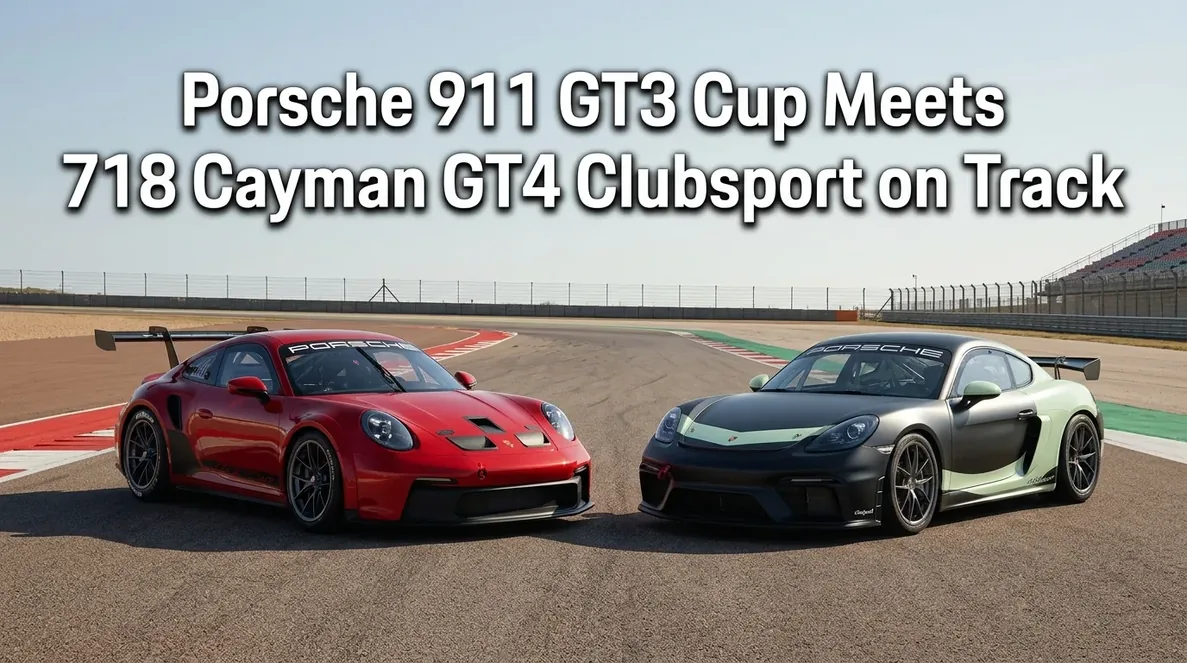
Two cars stand at the center of this comparison: the Porsche 911 GT3 Cup and the Porsche 718 Cayman GT4 Clubsport. Both vehicles compete on racing circuits in the United States. Each car reflects a distinct engineering philosophy. These differences shape results on the track across varied conditions and driver levels. The Porsche 911 GT3 Cup vs 718 Cayman GT4 Clubsport comparison helps drivers identify the more suitable option for their needs. Costs and eligibility for racing series in the United States also matter in making a choice.
Core Technical Overview
Porsche engineers the 911 GT3 Cup and 718 Cayman GT4 Clubsport with distinct concepts for circuit performance. Each car is intended for a specific category of competition. The Porsche 911 GT3 Cup specs and 718 Cayman GT4 Clubsport specs reflect different priorities in weight balance and power delivery.
| Specification | Porsche 911 GT3 Cup | 718 Cayman GT4 Clubsport |
|---|---|---|
| Engine layout | Rear-mounted boxer six | Mid-mounted boxer six |
| Displacement | 3,996 cc | 3,800 cc |
| Peak power | About 520 hp | 425 hp |
| Transmission type | Six-speed sequential | Six-speed PDK |
| Driven axle | Rear wheels only | Rear wheels only |
| Approximate weight | About 1,288 kg | About 1,320 kg |
| Power-to-weight | About 404 hp/ton | About 322 hp/ton |
| Primary use case | Cup series circuit racing | Clubsport and track days |
| Typical driver level | Advanced competition level | Developing to intermediate |
United States Availability Summary

In the United States, buyers receive Porsche customer racing cars according to the model year. Allocation and sourcing vary with each production cycle. Regional motorsport programs and racing series affect how these cars are made available to buyers. Buyers should review several points before ordering:
- Current 992.2 Cup allocation;
- 2026 Carrera Cup usage;
- Cayman GT4 Clubsport sourcing;
- Porsche Motorsport North America contact;
- Series-driven production volumes;
- Used race car market;
- Delivery timing considerations;
- Homologation paperwork needs.
Engine And Power Delivery
Each rear cover conceals a naturally aspirated flat-six engine. The two units differ in character and in how they deliver power. Each engine suits a different driving style. The main contrasts are:
- Higher peak power in the Cup;
- Cayman strong mid-range torque;
- Rev ceiling reaches 9,000 rpm;
- Individual throttles in Cup;
- Flat-six 3.8-liter unit in the Cayman;
- Four-liter displacement in the Cup unit;
- Throttle response differences;
- Power on long straights;
- Engine mapping for series.
Transmission And Driveline Operation
Power reaches the rear wheels using two systems. The GT3 Cup features a six-speed sequential dog-type gearbox. The 718 Cayman GT4 Clubsport uses a six-speed PDK dual-clutch transmission. Each system places different demands on the driver:
- Sequential pull-push shifting;
- PDK paddle-shifted automation;
- Clutch use differences;
- Shift speed comparison;
- Rear limited-slip function;
- Launch off slow corners;
- Driveline durability factors;
- Driver workload in traffic.
Chassis Layout And Handling Balance
In a rear engine vs mid engine Porsche race car comparison, engine position shapes how each car handles. When drivers push the car to its limits, engine placement changes how it responds. Drivers also notice differences in recovery after losing control.
| Handling Aspect | 911 GT3 Cup | 718 Cayman GT4 Clubsport |
|---|---|---|
| Engine position | Behind rear axle | Near vehicle center |
| Turn-in behavior | Gradual initial rotation | Sharp, immediate response |
| Power-on traction | Strong rear-axle grip | Neutral, balanced exit |
| High-speed stability | Planted rear end | Even front-rear load |
| Trail-braking response | Rotation builds quickly | Predictable weight shift |
| Forgiveness at the limit | Demands precise inputs | More accessible recovery |
| Setup sensitivity | Reacts to small changes | Broader adjustment tolerance |
| Effect of fuel load | Rear weight increases | Less rear-bias change |
Aerodynamics And Downforce Systems
Both cars rely on wings, splitters, and components beneath the body to generate downforce. Each team determines how to generate this load and chooses where to apply it on the track. The main aerodynamic elements are:
- Three-piece Cup front lip;
- Cup fender louvers airflow;
- Underfloor aero load generation;
- Swan-neck rear wing design;
- Cayman fixed rear wing;
- Sideblade integration details;
- Adjustability of wing angles;
- Effect on tire wear;
- Stability in high-speed corners.
Braking Hardware Comparison
Each car’s braking setup reflects how it slows from racing speeds. The hardware differs between the two cars, and these differences influence brake consistency during extended circuit sessions.
| Specification | Porsche 911 GT3 Cup | Porsche 718 Cayman GT4 Clubsport |
|---|---|---|
| Front disc diameter | Wider updated steel disc | 380 mm steel disc |
| Rear disc diameter | Updated rear steel disc | Smaller rear steel disc |
| Disc width | Increased ventilation width | Standard competition width |
| Material | Ventilated steel alloy | Ventilated steel alloy |
| Caliper piston count | Updated multi-piston calipers | Six front, four rear |
| Cooling method | Improved ducted ventilation | Standard duct cooling |
| Brake bias adjustment | Series-configured balance bar | Adjustable balance bar |
| Pad options | Cup-specification compounds | Multiple compound choices |
Weight Dimensions And Ratios
In the GT3 Cup vs GT4 Clubsport matchup, weight, balance, and power-to-weight ratio set the two cars apart. Engineers look beyond output. They use size and mass distribution to shape how each car behaves through every phase of a lap. As track conditions change, the effect of mass and dimensions shifts. The performance of both the GT3 Cup and the GT4 Clubsport changes with it. The key physical factors include:
- 911 slightly lighter shell;
- Cayman marginally heavier chassis;
- Power-to-weight advantage 911;
- Fuel load influence;
- Tire width interaction;
- Wheelbase and agility feel;
- Kerb behavior over laps;
- Impact on braking zones;
- Sprint versus endurance relevance.
Cockpit Controls And Data Systems
Both cars have stripped interiors focused on racing essentials. Controls and readouts are arranged for easy reach during circuit runs. Each car includes the following tools for circuit operation and driver development:
- Multifunction Cup steering wheel;
- Touch panel for settings;
- GPS-based timing display;
- Tire temperature readouts;
- Cayman motorsport center console;
- Data logging integration;
- Quick-access rotary switches;
- Alarm lights for protection;
- Driver workload simplification.
Track Day And Competition Use
Team managers choose either the Porsche 718 Cayman GT4 Clubsport or the 911 GT3 Cup depending on session type, available support, and driver skill level. Both models operate on private tracks, with each designed for specific racing formats and suited to different types of drivers. GT3 Cup vs GT4 Clubsport lap times differ by circuit, with the Cup car faster on open layouts.
| Aspect | Porsche 911 GT3 Cup | Porsche 718 Cayman GT4 Clubsport |
|---|---|---|
| Track-day friendliness | Lower, cup-focused | High, Trackday trim |
| Setup complexity | High | Moderate to high |
| Endurance fuel capacity | Series-dependent | 115 liters Competition |
| Tyre warm-up ease | Demands precision | More forgiving |
| Traffic tolerance | Low | Moderate |
| Driver learning curve | Steep | Gradual |
| Support crew needs | Extensive | Moderate |
| Ideal race distance | Sprint formats | Sprint and endurance |
United States Racing Series Relevance
Porsche customer racing cars participate in North American circuit programs, appearing in both dedicated one-make series and mixed-class GT4 championships. Events include sprint formats and longer endurance rounds. Each series has distinct technical requirements that influence car selection. Different cars fit various positions within the North American racing structure. The main eligibility and operational factors are:
- Carrera Cup 911 entries;
- Supercup style one-make use;
- GT4-based mixed grids;
- Eligibility via homologation documents;
- Tyre supplier dependencies;
- BoP affecting performance;
- Sprint versus endurance regulations;
- Licensing and test days;
- Support from regional dealers.
Costs, Maintenance, and Support
The Porsche 911 GT3 Cup price and running costs are higher: buyers invest more upfront, and expenses continue with consumables and scheduled service. Over time, running costs grow as drivers put the Cup car to use. Teams need to allocate a dedicated budget for it. The 718 Cayman GT4 Clubsport offers drivers an alternative, as it requires less money both to purchase and to maintain. The main cost categories include:
- Purchase outlay comparison;
- Brake disc longevity;
- Tyre set frequency;
- Fuel consumption differences;
- Gearbox service intervals;
- Engine refresh timing;
- Transport and storage needs;
- Data engineer staffing;
- Parts supply lead-times.
Conclusion
When choosing between Porsche race cars, individuals must first determine their own objectives. Both the Porsche 911 GT3 Cup and the Porsche 718 Cayman GT4 Clubsport are designed for competition and are eligible for circuit racing in the United States.
FAQ
Which Car Suits Different Drivers?
Engineers designed the 718 Cayman GT4 Clubsport to support developing drivers. This model provides circuit access, features mid-engine balance, and includes PDK shifting. The 911 GT3 Cup offers 520 horsepower and a sequential gearbox. Drivers seeking precise handling choose this car.
How Do Their Engines Produce Performance?
Both vehicles have naturally aspirated flat-six engines. The Cup model’s 4.0-liter engine delivers 520 horsepower and revs to 9,000 rpm, while the Cayman’s 3.8-liter engine offers linear torque, providing smoother throttle control that benefits newer drivers.
How Does Vehicle Weight Affect Lap Performance?
Weight affects both acceleration and braking in a car. The 911 benefits from its weight characteristics. Drivers can adjust weight distribution, tire usage, and fuel load. Through these adjustments, the mid-engine Cayman can match lap times on various circuits.